A slop in the face
An old friend of mine had a perfect metaphor for the feeling you get when you try to follow badly structured thinking. He called it a "flu brain." Imagine you have a severe fever and are trying to read an article. You understand the words separately but can't make sense of them together, lose your train of thought mid-sentence, and don't see the logical links between sentences.
It perfectly describes my experience of being online in the year 2026, as there's hardly any place left on the internet where you can be safe from the flattened average of humanity's body of knowledge being presented to you as an original thought, a.k.a. AI slop.
There are many reasons to hate AI. It steals the intellectual property of artists, writers, and creators, pollutes the air and water through data centers, and makes it almost impossible for recent graduates to find the entry-level jobs they need to gain those five years of experience required to apply for slightly better entry-level jobs. In this particular essay, however, I want to put all the ethical considerations of AI use aside and focus strictly on its outputs.
AI-writing is simply annoying.
"Actually" in every other sentence.
"Let's discuss why cybersecurity is actually important."
Do you notice how the word "actually" is doing the opposite of what it's supposed to be doing here? Do you notice how it weakens the argument and immediately puts the writer on the defensive? Even if you had no opinion on the topic, it immediately plants an idea in your head that most people think cybersecurity is NOT important, but now the author will save you from your ignorance and explain why you're actually wrong. The sentence retroactively assigns you a dumb opinion, and then talks down to you for having it.
Everything is measured in "decades."
"The music business spent a decade litigating Napster and its successors."
And a few sentences later:
"The publications that look least alarmed right now made a different set of decisions, mostly a decade ago."
Unfortunately, that's a real example from an article I read recently, from a magazine I like and (still) am a subscriber to. If you do a simple Google search, you'd quickly find that the most well-known Napster case lasted about two years, and even if you consider the whole litigation arc, it was closer to seven years. And that's what a thorough human journalist would likely write, as in this pre-AI-era article from Wired: "Napster Trial Ends Seven Years Later." "Spent a decade" is a vague overstatement, very typical of AI, which tends to flatten everything to the same round units.
Everything happens "quietly" now.
"The shift might quietly redefine our relationship with the planet."
"Is China quietly winning the AI race?"
"Social media platforms have quietly become the primary source of news for millions."
AI likely learned it from tabloids that love manufacturing drama when they can't find a real one. And what could be a better way to manufacture drama than to tell you that something big is happening under your nose, you don't notice it, and by the time you do, it might be too late? That framing works especially well on us due to our intrinsic negativity bias, a well-documented human tendency to notice, remember, and react more strongly to negative events than positive ones. It's often explained as an evolutionary survival mechanism. Early humans who treated anything unfamiliar as a potential threat were more likely to survive and pass on their genes. Their more laidback contemporaries were probably eaten by crocodiles they wanted to pet.
As an added bonus, negative information is also more likely to be shared. We're a social species and we tend to warn others of possible threats. Sharing information that feels important but overlooked makes us feel like "insiders," slightly ahead of others.
I don't know if exploiting human psychology for rage-bait clicks and ad views was Tabloid Journalism 101 or if each tabloid eventually figured it out by themselves, but now helpful AI does it for them for free and at scale. Thank you for your service, ChatGPT!
A sentence. Another sentence. Mic drop.
"Both stories are true. Neither addresses the actual problem."
"The future is already here. Most people just haven't noticed yet."
"The facts never changed. Only the framing did."
"There's no playbook for this. No precedent. No one is coming to save you."
"The market shifted. The customers moved on. The team never noticed."
AI writes like an overcaffeinated intern at an ad agency who thinks he's an upcoming artist misunderstood by society. It just loves this melodramatic tone of voice, sentence fragments, tricolons, and staccato patterns. Everything comes in groups of twos and threes and sounds like yet another slogan for a Dunkin' Donuts commercial.
Cheesy metaphors with "benefits."
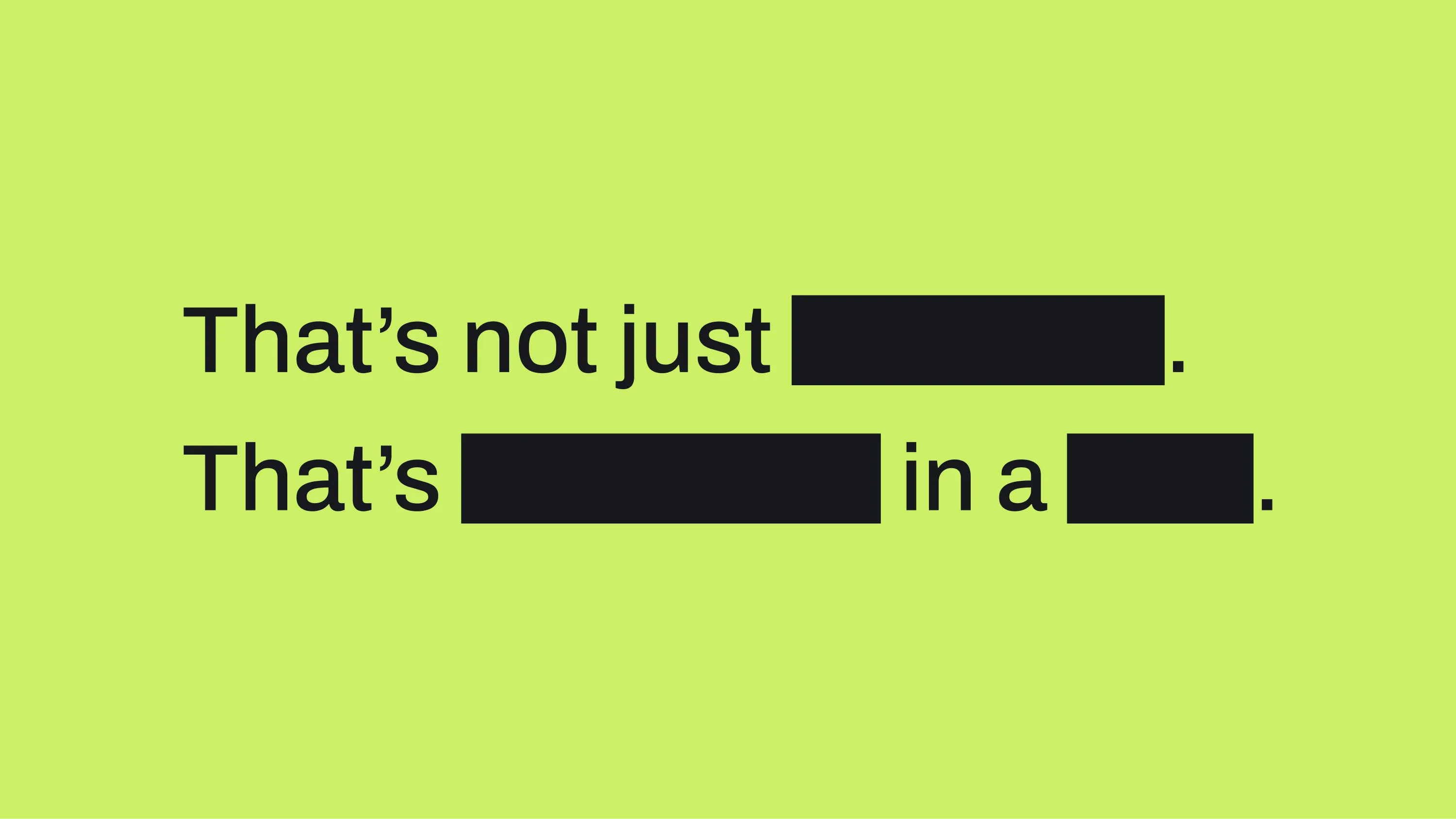
"That's not coffee. That's 3 hours of focused work in a cup."
I get it, "1000 songs in your pocket" pitch from Apple about the iPod in 2001 was great, especially when everyone else was talking about megabytes of storage and other technical characteristics. But you need to read the room here, chief. At the time, I had to carry a whole backpack for my CD player and a zip-up CD binder with 20 CDs to be able to listen to more than one album during the day. So having "1000 songs in your pocket" was genuinely impressive, on the verge of impossible.
AI can come up with a line this good only by statistical accident, because it doesn't have the capacity to understand today's context, with all the real human truths, pains, and insights. That's why most of the time AI headlines and metaphors end up sounding tacky and cheap.
Human reasoning is reduced to "instincts."
"Your instinct is doing real work."
"That's the right instinct."
It's not an "instinct," you stinking pile of interpolated matrices. I am not some filthy animal, operating on "instincts" alone. I can spot logical gaps in your synthetic writing precisely because I can think rationally, ask questions, and evaluate links between premises and conclusions.
Skipped logical steps.
"The traffic looked like loyalty but this was an illusion."
What? These are completely different categories, and they don't resemble each other in the slightest. Traffic is a metric, and loyalty is an attitude. The sentence is trying to make a comparison without stating the basis for it. Grammatically, the sentence is fine, but it makes you reconstruct all the implicit assumptions the author left out.
A human writer would usually establish where the logical link between these things is, and then explain why it was misleading. The thought buried here is something like "the steady traffic numbers fooled us into thinking that we had loyal repeat customers, but they were just different people passing through."
Assigning actions and qualities to inanimate objects.
"Seeing the numbers was not enough to hold their choice steady."
Humans invent new metaphors purposefully. It's usually a clever observation of the likeness of two seemingly unconnected things. Something like "Sunlight embraced me in its warmth." The light can't physically embrace you, but the sunlight is warm, and the embrace does feel warm, so describing it that way conveys the feeling very precisely.
AI produces metaphors accidentally, while trying to describe something "vividly." Most of the time these metaphors don't make any sense, because they hand physical actions to things that can't perform them, and just muddy the meaning. The sentence above about "holding the choice steady" was supposed to mean that the numbers made them reconsider and change their choice. But the only image I get from this "vivid" AI description is a person trying to hold a tray in one hand with a plate of some wobbly substance called "choice" in it. You can't "hold a choice steady." It's not a thing with weight or balance, but AI writes as if it were.
And the rhetorical questions? That's bullshit.
"She trained through a brutal Chicago winter, running before dawn while the streets were still sheeted in ice. The lesson for your sales team? Consistency beats intensity."
In normal human writing, rhetorical questions usually logically follow from the text, and serve as connective tissue for the storyline. It's something a reader, following the writer's train of thought, would naturally ask, so the writer foresees the reader's intent and answers it.
In AI writing, on the other hand, rhetorical questions are usually forced and abrupt, and don't follow naturally. They are just low-cost attempts to patch together a few thoughts without building a clear logical bridge between them.
The list above is far from being complete, but I think you get the idea by now. I can't help but mentally check out once I see a few of these AI markers in the text. I feel like I'm being served some processed microwaved food when I was promised a home-cooked meal.
At the same time, I'm not totally against AI. I use it for tedious mechanical tasks, which it performs objectively faster than I do. And if you can make AI writing sound natural and coherent — good for you, I won't complain. The problem is that initial AI output usually looks plausible on the surface, and fixing the logical gaps below the surface requires time and discipline. When people are doing work by hand, they have at least some inclination to apply the time and discipline to the thing they are putting out into the world under their name. But since the AI output doesn't quite feel like their work, the attitude tends to shift towards "Fine, whatever. At least it was fast..."